
By Heather Marchand
If there is one misconception lumberyards need to let go of, it is this: deck builders are not small-time buyers. In the combined NADRA survey of 37 builders, 49% reported having five employees or fewer. At the same time, 44% are building 51 or more decks per year. That combination matters.
The backyard that started it all
In 1992, my parents, Mike and Margie Beaudry, had a decision to make. They had just welcomed their fifth child and were staring down the familiar family dilemma: take a summer vacation or invest that money closer to home? They chose the backyard.
At the time, none of us understood what that decision really meant. We just knew our house became the place. The neighborhood hangout. Bikes piled in the driveway. Shoes kicked off at the edge of the deck. Summer stretching long after the sun went down.
Now, as a mom of four myself, I understand. They weren’t just building square footage. They were building space for connection. For family. For memories that quietly shape how we understand home.
That backyard decision came years before decking became what it is today, before outdoor living turned into a full-scale industry, before composite boards and curated railing systems and six-figure projects. Somehow, they saw the big picture early. A deck wrapped around the pool. A hot tub. A grill. Lights that kept the evenings going. A place that brought people together.
Why I’m sitting at this table
Fast forward a few decades, and that backyard still matters more than I ever expected. It shaped how my parents approached this industry and why helping build the North American Deck & Railing Association (NADRA) always felt rooted in family and connection.
Today, my work sits at the intersection of builders, manufacturers, distributors, and dealers. After years of working alongside deck builders of all sizes, I’ve gained a close view of how their operations truly function.
Over the past couple of months, I gathered input from deck builders across the country through a detailed survey and followed up with one-on-one conversations. One question framed every call: What do you wish your lumberyard truly understood about your business?
No one asked for swag. No one mentioned lunch-and-learns. The answers were about operational pressure, communication, and what it feels like when a job stalls because something small went wrong.
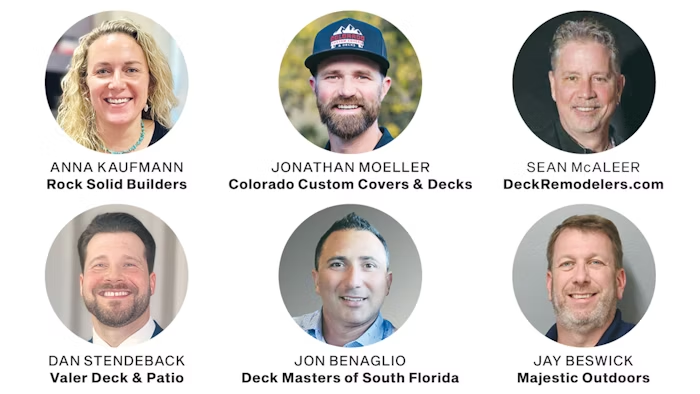
Anna Kaufmann of Rock Solid Builders in Illinois produces more than 100 decks a year with a streamlined system built around planning months ahead and limiting product variables. When you run that kind of volume with a lean team, material availability is not a preference. It is survival.
Sean McAleer of DeckRemodelers.com in New Jersey builds high-end outdoor spaces where details matter and communication cannot slip. For him, the question is simple: when something goes sideways, will someone answer the phone?
Jonathan Moeller of Colorado Custom Covers & Decks works in a climate where logistics, loading, and staging are part of the build strategy itself. He talked about the importance of yards understanding how material is actually handled on-site, not just how it is invoiced.
Jon Benaglio of Deck Masters of South Florida operates in a coastal market where hurricane season, million-dollar hardwood projects, and tight deadlines are real pressures. He told me trust outweighs price every time, especially after seeing which suppliers showed up when storms shut everything else down.
Dan Stendeback of Valer Deck & Patio in Fairfax, VA described himself as relationship-driven with low supplier churn. After losing months to a mismanaged order early in his business growth, honesty and knowledgeable partners became non-negotiable.
Jay Beswick of Majestic Outdoors in Durham, NC builds outdoor living spaces that regularly range into six figures. He has stayed loyal to the same lumberyard for nearly two decades. Not because they are the cheapest, but because they understand design, logistics, and quality at the level his
projects demand.
Together, along with 37 NADRA builders who completed the survey, these six deck builders paint a clear picture of what earns an LBM dealer long-term loyalty.
Small teams. Serious volume. Zero margin for error.
If there is one misconception lumberyards need to let go of, it is this: deck builders are not small-time buyers. In the combined NADRA survey of 37 builders, 49% reported having five employees or fewer. At the same time, 44% are building 51 or more decks per year. That combination matters.
These are lean teams running high-output operations. They are scheduling crews tightly, managing inspections, juggling weather, handling homeowner communication, and protecting margins, often all at once.
Anna Kaufmann builds more than 100 decks annually with a streamlined, composite-focused system. “We’ve built our process around efficiency,” she said. “If one item is missing, the entire job can stall.”
In high-volume environments, small mistakes multiply. A delayed railing shipment does not just push a job back a day. It can trigger crew reshuffling, inspection rescheduling, and difficult homeowner conversations.
Jonathan Moeller sees the same dynamic in a very different climate and market. “Homeowners don’t care whose fault it is,” he said. “If something doesn’t show up when it’s supposed to, we’re the ones standing there.”
Builders are not simply buying product. They are buying continuity. Across the survey, ease of doing business consistently ranked among the highest priorities, ahead of credit terms and breadth of product offering. On-time, accurate delivery also ranked near the top.
Availability and quality are the baseline. The real difference shows up in the small moments. How quickly someone calls back. Whether an order is staged correctly. Whether a problem gets handled without drama.
Dan Stendeback said it directly. “We don’t have extra hours built into our day. If I leave a jobsite to fix something that shouldn’t have gone wrong, that costs us.” He is not alone. For owner-led teams managing multiple projects at once, time spent waiting at a loading dock is not neutral. It pulls them away from oversight, problem-solving, and revenue- generating work.
Growth opportunity lives here. Not in adding another SKU, but in tightening systems: accurate staging, clear communication, realistic delivery windows, and faster load times. Small efficiencies compound into loyalty.
Relationships rule
In a pricing-sensitive market, it would be easy to assume cost drives every decision. The survey says otherwise: 84% of respondents said relationship and trust earned their lumberyard’s primary role; 86% said strong relationships keep them loyal long term.
Competitive pricing matters. But price alone does not secure the account. Kaufmann is clear about that distinction. “No one can beat our lumberyard on price because of the volume we do,” she said. “But what really mattered was during downturns, when we struggled, they worked with us.”
Sean McAleer sees it similarly. “If there’s a problem, I need to know someone’s going to answer the phone,” he said. “Communication is everything.”
Relationships in this channel are not a soft benefit. They are operational security. A full 70% of builders say they rarely switch primary lumberyards. Switching is uncommon. But once trust is broken, it is difficult to repair. Indeed, 73% said loss of trust would cause them to leave. Other deal-breaker issues included poor communication (63%) and delivery problems (59%).
Price increases ranked lower than communication failures. Builders tolerate market fluctuation. They do not tolerate repeated communication breakdowns.
Operational partnership
Across nearly every conversation, relationship was not described in abstract terms. It was described through moments.
Kaufmann stayed loyal because her yard worked with her during hard seasons.
Beswick speaks about specific individuals by name after nearly two decades of partnership.
Stendeback left after repeated communication failures cost him credibility with clients.
McAleer builds long-term partnerships, not purchase orders. In a market where expectations are high and timelines are tight, he expects accountability and proactive communication from his lumberyard. Responsiveness is not a courtesy. It is part of the agreement.
Over time, something else happens. The language shifts from lumberyards to names. Builders describe being close with owners. Attending events together. Celebrating awards together.
It becomes familiarity. It becomes trust. Sometimes, it becomes friendship. Not casual friendship. Earned friendship. Built through jobsite visits when something fails. Through credit extended during tight seasons. Through showing up.
Switching lumberyards is rare. But when it happens, it is rarely about one invoice. It is about accumulated failures. In this channel, relationship is not networking. It is operational partnership.

Builders don’t want more brands
Our survey showed that 59% of deck builders use 2-3 brands; 41% use only 1. Not one builder reported using four or more brands.
That is not accidental. These are not contractors chasing the newest line every year. They are narrowing their product mix on purpose. Training. Inventory coordination. Warranty knowledge. Crew adjustments. Risk evaluation. Every additional brand adds moving parts.
Builders create systems around what they know. Their crews are trained on it. Their sales process is built around it. Their warranty conversations are aligned with it.
In the survey, a lumberyard offering a wide range of products ranked lower than ease of doing business, delivery accuracy, quality, and relationship. That tells you something.
Most professional deck builders do not want endless options. They want the right products, consistently available, with people behind the counter who understand them. When builders feel confident in what will arrive, how it will perform, and how it will be supported, they buy more of it. Not because it is new. Because it is reliable.
Builders want fewer surprises
If the data and interviews point to one overarching truth, it is this: lumberyards win when they remove unnecessary obstacles. Builders are not asking for more perks. They are asking for fewer surprises. Tighter staging. Reduced loading dock wait times. Realistically confirmed delivery windows. Immediately communicated backorders. Knowledgeable staff.
These are operational improvements. For lean teams building 50 or more decks annually, small efficiencies compound. When builders trust that materials will arrive correctly and on time, they can schedule confidently, protect margins, and focus on the homeowner experience. And when they can do that, they buy more.
Systems vs. projects
One theme that surfaced quietly in several interviews is how differently builders and lumberyards often think about the same transaction. Builders think in systems. They plan months ahead. They sequence inspections. They coordinate trades. They standardize product selections. They limit brands. They train crews around specific installation details.
Kaufmann talked about ordering materials months in advance and intentionally narrowing product variables to protect workflow. That is not convenience. It is structure.
Moeller described pushing for changes in how materials were delivered and unloaded because jobsite logistics are part of execution, not an afterthought.
McAleer builds around predictability. When he aligns with a lumberyard, he is not just choosing a price point. He is integrating that yard into his process.
Beswick emphasized understanding design intent and quality standards at a level deeper than invoice totals. His lumberyard knows what kind of projects he builds and what that requires.
This is where disconnect sometimes happens. Where lumberyards may see orders, builders see sequence. A substituted railing component may feel minor at the counter. In the field, it can disrupt training, design consistency, or warranty alignment throughout a project. When builders limit brands, plan deeply, and build repeatable processes, they are reducing variability.
The lumberyard that understands that system and aligns with it becomes embedded in the operation. The one that treats each order as independent never fully integrates—and doesn’t become the supplier of choice.
At the end of the day, yards who succeed in growing sales to deck builders will focus less on stocking more product options and focus more on understanding how their core builders actually build.

Where trust builds more than decks
Backyards have changed since the early 1990s. Materials have evolved. Projects have grown in size and complexity. Homeowners are investing at higher levels than ever before. But the foundation of this industry has not changed.
Connection is still at the center of it. Connection between families and the spaces they gather in. Connection between builders and their clients. Connection between builders and the lumberyards they rely on.
The survey data makes it clear. Builders do not switch suppliers often. Instead, they build long-term relationships. They stay where they feel understood. They stay where communication is clear. They stay where trust has been earned.
Trust is not built through promotions. It is built through consistency. Through answering the phone. Through honest timelines. Through showing up.
Over the years, I’ve watched that same principle play out through NADRA. When builders, dealers, distributors, and manufacturers sit at the same table, celebrate projects, and solve problems together, something shifts. The industry feels smaller. More connected. More human.
If you search Instagram for @NADRARocks, you will see beautiful projects. You will see award nights and jobsite photos. But what you will really see is relationships in action. Builders cheering each other on. Dealers showing up. People who compete during the day shaking hands at night.
That culture did not happen by accident. It happened because people chose to treat each other like partners instead of transactions. Lumberyards that adopt that same mindset position themselves differently. Not as order-takers or price sheets, but as part of the builder’s extended team.
In the end, growth in decking does not come from stocking more products. It comes from strengthening the relationships that move them. Because long after a project is complete, what remains is not just a deck. It is trust.
Source: LBM Journal Read original HERE