
Featured Article Sponsored by DeckBuild, Proud Member of NADRA.org
Written by Phil Black, DeckBuild
If you own a deck building company, your responsibilities are endless. In the morning you are the estimator, by noon you are the designer and the salesperson, in the afternoon you are the project manager, and by evening you are the drafter, finishing construction drawings while everyone else is asleep. Somewhere in there, the “leader” role needs to come out too.
Nobody starts a deck company because they dream of paperwork. Many owners started as good builders who loved building, to free up their time not to buy an 80-hour a week job. The trouble is that the skill that got the company off the ground quietly becomes the ceiling on it. Think about that. When every price, drawing, and decision runs through one person, the business can only grow as fast as that person’s calendar allows. It’s finite. You don’t scale.
The real pain is rarely the workload by itself. It’s prioritization. It’s not knowing what deserves your attention, and never having enough uninterrupted time to give it. Here’s how to fix both.
Busy Is Not the Same as Productive
A full day and a productive day are different things. Owners who feel constantly behind are usually doing plenty of useful work, just not the right work, not the work that moves the company forward. Important tasks are rarely urgent, and urgent tasks are rarely important. But somehow urgent tasks win every time: a crew question, a homeowner’s text, a call about tomorrow’s delivery. They feel important because they are loud. The work that actually grows a business, like hiring, training, building relationships, and improving your systems, is quiet. It never calls you, so it never gets done.
Prioritization is the skill that separates owners who scale from owners who stall, and it starts with one question: what is most broken right now?
Find the Problem Behind the Problems
Every company has a bottleneck. Before deciding what to work on, ask which single fix would ease the most other headaches. If estimates go out late, you lose jobs and stack stress onto your production schedule. Fix the root and a whole set of smaller problems disappear. Ignore it and you will spend the year treating symptoms.
Then narrow your daily focus. A to-do list with twenty items has no priorities, because everything on it looks equally important. Choose the three things that matter most today, protect them, and treat everything else as a bonus.
Schedule the Important Work Before the Day Fills Up
Priorities that live only on a list lose to whatever shows up first. Put them on your calendar and treat them like appointments with a customer. Owners who do this well tend to build a repeatable week:
- A set day, or set blocks, for estimating and design, so nothing has to be squeezed in
- Set windows for sales consultations, and limit nights and weekends
- One block for the office: ordering, job scopes, payroll, and follow-ups
- A protected block each week for planning, thinking, and reviewing your numbers
- A little open time, because fires will happen no matter what
Notice what is missing from that list: estimates and drawings at ten o’clock at night. Work done by a tired brain takes longer, and it is where pricing mistakes and missed materials creep in. If a task keeps landing in your late evenings, it does not need more willpower. It needs a better system.
Move From Doing to Leading
Even a perfect calendar cannot rescue an owner who is still the answer to every question. A company rarely outgrows the habits of the person running it, and a leader’s real job is building the team that does the work.
That starts with hiring great people and giving them real ownership. When a crew lead calls to ask permission to do something they are fully qualified to do, resist handing down an answer. Ask what they think, agree when it is sound, and tell them they do not need to call next time. Every decision you hand back returns time to you and builds skill in them.
It also means investing in relationships. The contractors who thrive know their employees’ birthdays, stay in touch with past customers, and earn referrals because every homeowner felt taken care of. Relationships are built in unhurried moments, and those only exist when your calendar has room in it.
Finally, give the team a scoreboard. Pick one or two numbers that matter, such as how many days it takes to get an estimate to a homeowner, or how closely your final material cost matches what you bid, and review them every week. Attention follows measurement.
Where Is Your Time Actually Leaking?
If you are not sure where your hours are going, look for these signs:
- Estimates reach homeowners days after the site visit, when a competitor has already responded.
- You are finishing construction drawings at night or on the weekend.
- You are not closing as many deals as you should, even though the leads are there.
- The material bill on a finished deck comes in higher than what you bid.
These are one problem wearing four faces. Drawing a deck, framing it, counting every board and fastener, and turning that into a price is manual, repetitive work that depends on you and takes hours. Slow processes hurt speed, guesswork hurts accuracy, and sales suffer with both, because a homeowner comparing bids notices who came back first with something clear and professional.
If that sounds familiar, this is where the right tool earns its keep. Use the software deck pros already use.
Where DeckBuild Fits In
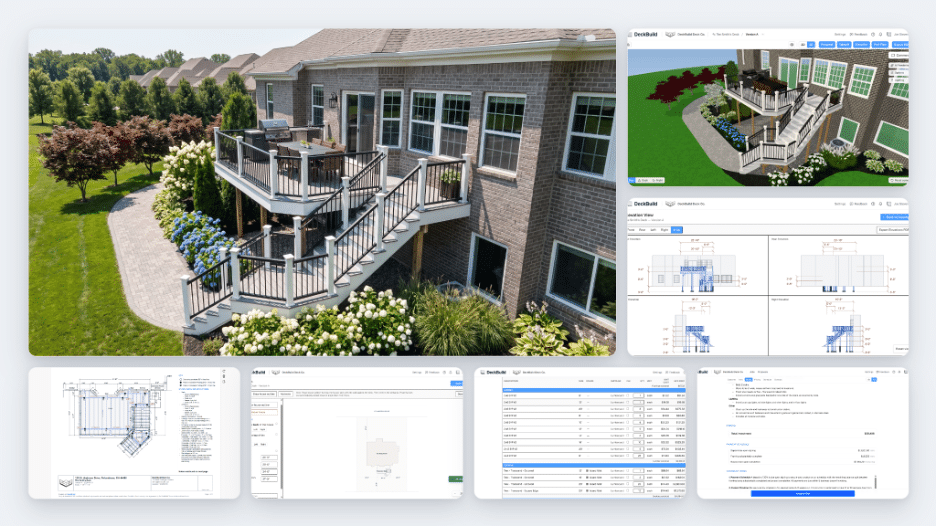
DeckBuild is software built specifically for deck contractors, and it goes straight at the manual work that fills your days and evenings. You simply draw the outline of any shaped deck, and DeckBuild turns that single drawing into everything you need, automatically, all at once: a permit-ready plan set, a complete material takeoff, a 3D model, and a priced estimate and proposal. Plans and takeoff take less than a minute, not a night at the kitchen table.
The framing generator lays out posts, beams, joists, and blocking to your local code and the way you actually build, using your footings, hardware, and decking brands, and you can override anything. The permit-ready plan set includes plan and elevation views, framing layout, and a footing load schedule, all with your branding. The plans are prescriptive and code-based, based on your local code, your costs, and how you build.
That speed shows up in your sales. Because pricing is built from your real material costs, labor, overhead, commission, and margin, the estimate and proposal is ready the moment the drawing is done, with e-signing built in. Estimates that used to take days can go out the same day, and you stop pricing decks on a hunch.
It also goes after that surprise on the material bill. DeckBuild’s solver frames each deck dozens of different ways and returns the most cost-efficient, code-compliant option based on your prices. The material takeoff itemizes every board, hanger, and fastener, with your stock lengths and supplier pricing, so you order once and skip the extra supply runs. The number in your estimate matches the material you actually buy. Across decks, DeckBuild’s average material savings comes to $542 per deck.
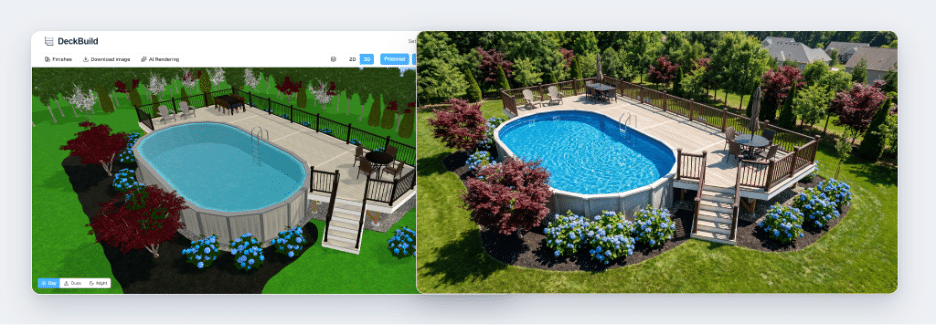
Every drawing also becomes a photorealistic 3D visualization you can walk homeowners through, changing colors, railings, and finishes on the spot, so they can picture the deck on their own house before they sign.
DeckBuild supports the shift from doing to leading as well. Company-wide defaults for your span tables, build methods, supplier catalogs, and branding mean anyone on your team can produce plans and estimates that match how you build. Your designers and salespeople can carry more of the load, and you stop being the only person who can price a deck.
It runs in any browser, at the kitchen table with a client or back in the office, and you do not need CAD skills. And if something about how you build is truly unique, the DeckBuild team will work with you to build it out at no charge.
The best way to judge it is on your own work. Start a free 14-day trial, with no credit card required, draw a real deck, and see how much of your week comes back. Want to see it first? Watch the full demo.
Give Your Best Hours Back to the Business
Time is the one resource you cannot get more of, and as an owner, it is the one everyone is asking you to spend. Decide what deserves it. Put the important work on the calendar, hand off what others can do, and let good tools take the repetitive work that has been eating your evenings.
A deck company is at its best when its owner has the space to lead. Start this week by protecting one block of time. Then take the next drawing that would have cost you a night and see how quickly DeckBuild gets it done.