Featured Article Sponsored by BuildTuff, Proud Member of NADRA.org
For most of the deck-building industry’s history, the foundation conversation has been a short one: dig the hole, set the footing, pour concrete, wait. Where poured footings weren’t practical, builders reached for precast concrete deck blocks – heavy, awkward, and frustratingly inconsistent, but familiar enough to get the job done.
That equation is now being tested. Labour shortages have made skilled footing crews harder to find and more expensive to retain. Timelines are tighter. And a growing segment of the market – low-profile decks, ground-level platforms, renovation retrofits – does not always lend itself to traditional methods at all. Against this backdrop, a new generation of engineered floating deck foundation blocks has moved from niche workaround to legitimate professional tool. The best are now ICC-ES certified, independently load-tested, and designed to slot directly into standard framing workflows.
The Real Cost of the Traditional Footing
Professional deck builders have historically worked with two foundation options – and neither is without its frustrations.
Concrete footings are proven and permanent, but the honest accounting goes beyond materials. Holes are augered to frost depth, tube forms placed, concrete poured or mixed on site – then the project waits. That cure window can run 24 to 72 hours, enough to push a weekend build into a second mobilisation. Add auger rental, concrete mixing, and the physical toll of the work, all before a single board is cut.
Precast concrete blocks offer a faster alternative, but arrive with their own headaches. At 30 to 50 lbs each, transport and positioning are a logistical challenge. Moulded notches are often inconsistent between manufacturers, leaving builders chiselling out excess concrete just to seat a 4×4 cleanly. And with no adjustability once placed, levelling on sloping ground means time-consuming shimming and re-grading.
For renovation and retrofit projects, both methods add further complications – impractical or impossible where existing pavers, underground services, or tight access corridors make excavation a significant disruption.
A Closer Look at Floating Deck Foundation Blocks
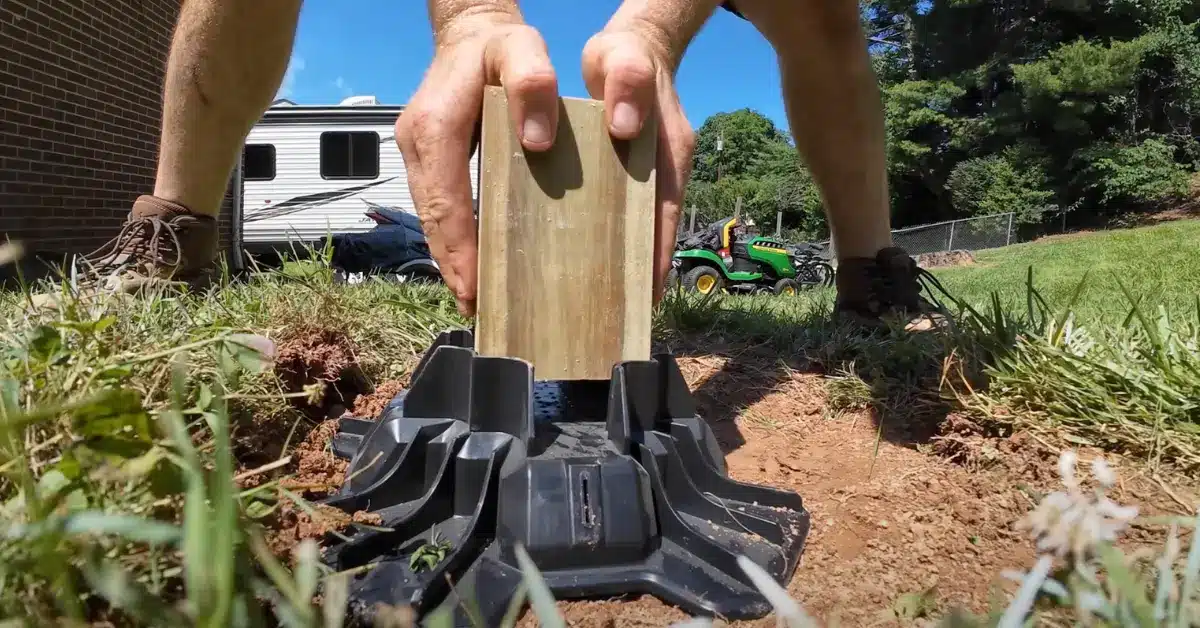
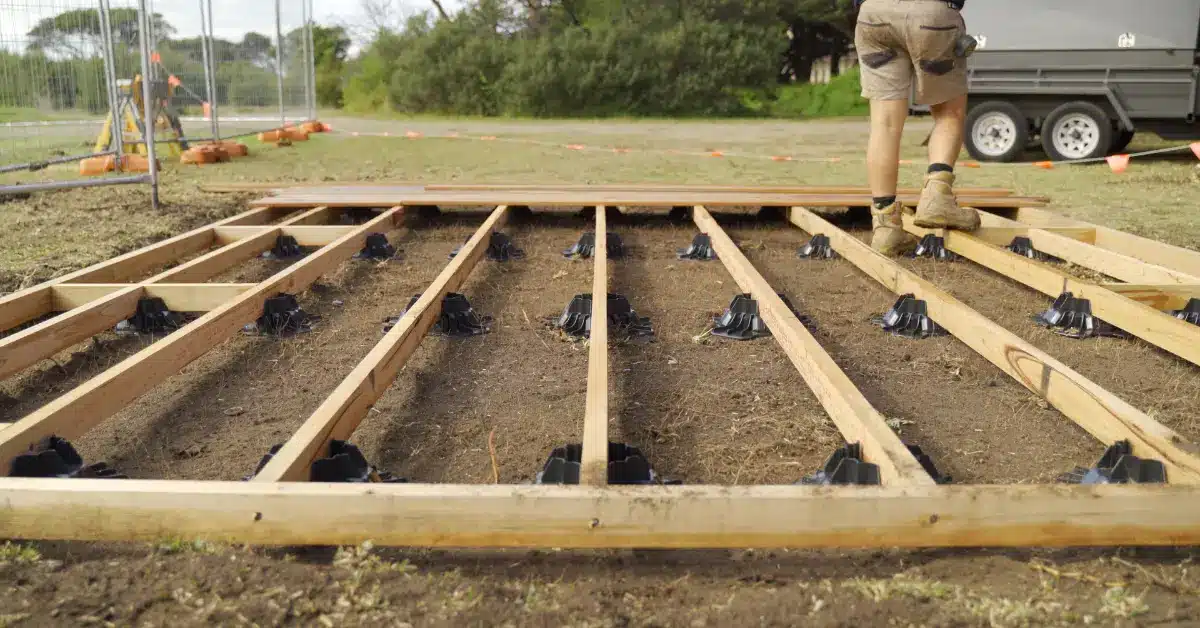
Floating deck foundation blocks are pre-formed structural supports that sit on a prepared surface and carry the full weight of a deck frame above them. No digging. No concrete. No curing time. Posts and joists drop directly into moulded saddle grooves sized to standard dimensional lumber.
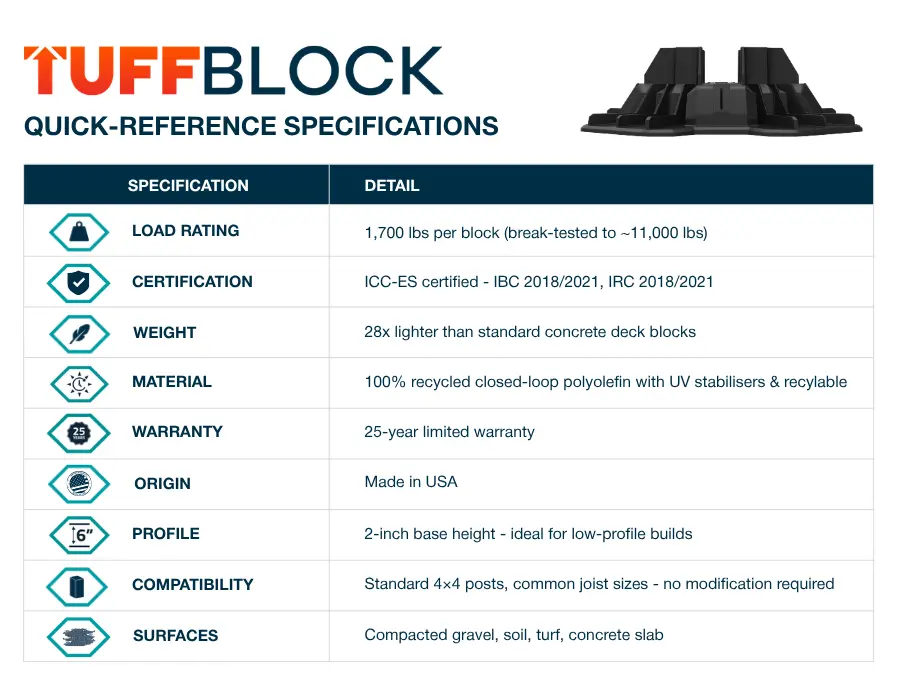
What has changed in recent years is the engineering rigour behind the best products. TuffBlock has undergone independent structural evaluation through the ICC-ES – the same body that evaluates products against the International Building Code and International Residential Code. That means documented, third-party verified load data, not just a manufacturer’s claim. TuffBlock is rated to 1,700 lbs per block, break-tested to approximately 11,000 lbs, and its ICC-ES evaluation covers state-level codes including California and Florida – meaningful for builders operating in those markets.
Where Floating Foundations Make Practical Sense
Not every deck is a candidate for a floating foundation system – and no credible manufacturer would suggest otherwise. But for the right build types, the case is compelling.
Low-Profile and Ground-Level Decks
Ground-level builds are in high demand, yet traditional concrete blocks sit too high for many of them. TuffBlock’s 2-inch base height makes low-profile builds achievable across virtually any surface – compacted gravel, soil, grass, turf, or pavers – and in areas where digging simply isn’t an option: over underground plumbing or electrical services, on existing concrete pads, or where tree roots make excavation impractical.
Renovation and Retrofit Projects
Existing hardscape is one of the most common constraints in renovation work. Replacing a patio, extending an existing structure, or adding a ground-level platform adjacent to a pool or garden area often means working over or adjacent to surfaces where digging is not an option.
Floating blocks install on compacted gravel bases, soil, turf, or concrete – giving builders workable solutions in scenarios where traditional footings would require significant demolition or workaround engineering.
Small Footprint Builds and Accessory Structures
The outdoor living market has expanded well beyond large decks. Pergola platforms, garden outbuildings, mudroom landings, and compact entertaining areas all require a foundation – but rarely justify the investment of a concrete footing installation. Floating blocks provide a proportionate, professional solution for structures where the foundation cost would otherwise be disproportionate to the project value.
Frost Heave Considerations
One of the most common concerns around floating foundations in cold climates is frost heave. Because floating systems move with seasonal ground movement rather than resisting it, they can often perform more predictably for low-profile structures. Proper site preparation – including a compacted gravel base and good drainage – remains critical.
The Labour Efficiency Argument
Efficiency in deck building is rarely found in a single dramatic improvement – it accumulates in the details. Eliminating the footing phase touches several of the most friction-heavy moments in a typical build.
There is no auger to rent, transport, operate, or return. There is no concrete to order, batch, or mix. There is no cure window to schedule around. In the case of concrete blocks, there is no heavy blocks to chisel, shim, or wrestle level. Foundation installation becomes a same-day task: prepare and level the compacted gravel base, position the blocks, drop the frame in.
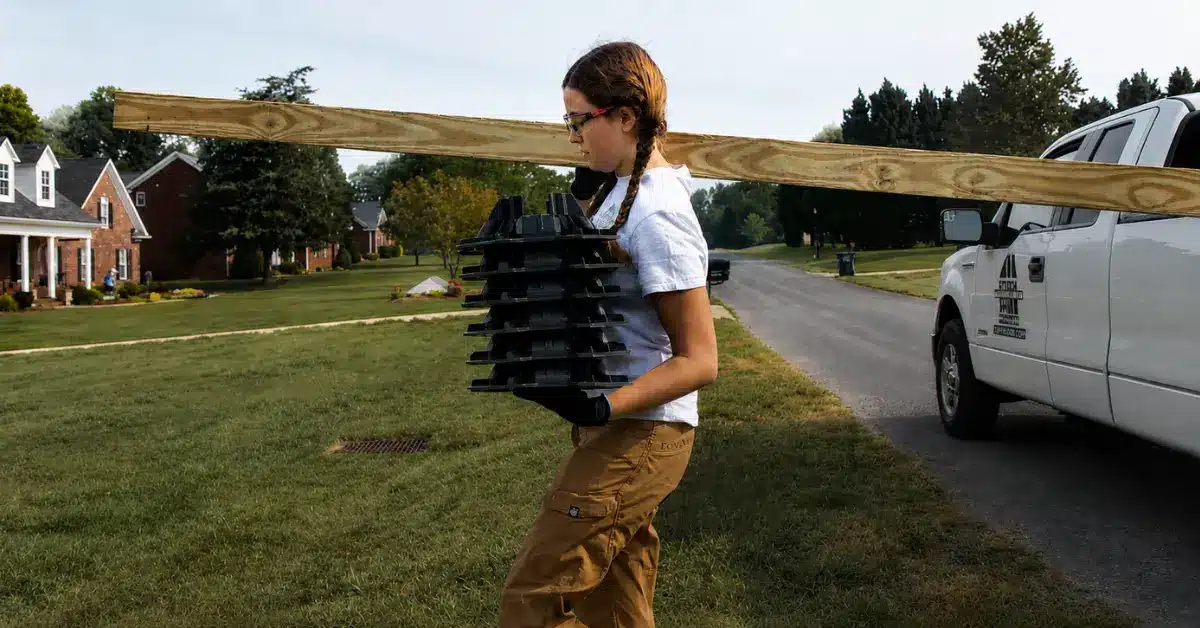
At 28 times lighter than traditional concrete deck blocks, TuffBlock changes the logistics before a single joist is cut. They ship free directly to your shop, fit in the boot of a standard car, and can be carried to the work area in one trip by a single installer – no truck, no delivery coordination, no materials-handling labour. On site, positioning and levelling is a one-person job. For a builder running a lean crew, that kind of friction removal across every foundation stage adds up to real time saved per project.
The time saving also carries downstream benefits. Faster foundation completion means framing begins sooner, which means the project finishes closer to the quoted timeline – a factor that increasingly affects builder reputation and referral volume in a market where online reviews carry real weight.
The real-world feedback from working builders reinforces this. Jerry of Site Built Sheds in Charlotte, NC reports saving 30 minutes to an hour on every shed foundation, while Russell of Shedscape in Greenville, SC credits TuffBlocks with making the levelling process on sloping yards significantly easier – freeing his crew’s energy for the structure itself rather than the footings.
What to Look for in a Floating Deck Block
The market includes products at widely varying quality levels. For builders whose reputation rests on every structure they put their name to, knowing how to evaluate matters more than any single brand recommendation:
- Independently verified load rating with published certification data
- ICC-ES certification or equivalent third-party structural evaluation
- Known material composition with UV stabilisation for long-term outdoor performance
- Compatibility with standard dimensional lumber without modification
- Documented warranty and traceable manufacturing origin
- Specification documentation suitable for permit submission
The proliferation of unverified imports makes due diligence essential. Products without load certification, material disclosure, or third-party testing data present genuine liability exposure – regardless of price point.
A System Worth Evaluating
Floating deck foundations are not a universal replacement for concrete footings. Attached decks, elevated structures above 40 inches, and anything requiring a permit in a jurisdiction with specific footing requirements will continue to demand traditional methods – as they should.
But the deck industry builds a significant volume of structures where floating foundations are not only appropriate, they are arguably the better technical choice: ground-level platforms, renovation builds over existing hardscape, accessory structures, and low-profile outdoor living installations. For these applications, dismissing engineered floating blocks as a DIY product reflects an outdated view of what the category now offers.
When the product has been ICC-ES certified, independently load-tested, made from traceable materials with a long-term warranty, and designed to work within standard framing conventions – it deserves a serious professional evaluation.
The foundation is where the build begins. Getting it right, efficiently and to code, is part of what defines professional-grade work in a market that increasingly rewards both technical excellence and business performance.
For builders who want to go deeper, BuildTuff has published a complete floating deck foundation guide covering site preparation, block spacing, load calculations, and cold-climate considerations.